
On Colonial Reparations
A deeply stupid idea whichever way you approach it, no matter what the United Nations has to say...

According to the Indian Marxist economist Utsa Patnaik, the British Empire “drained” about $45 trillion from India between 1765 and 1938. That was seventeen times the size of the entire British economy at the time it was calculated.
How did she reach such a ridiculous figure? Patnaik used historical tax and trade data, treated India’s export-surplus earnings as the measure of the supposed drain, and then compounded the total forward at an arbitrary 5 per cent interest rate.
Two can play at this game.
In the late 1330s, Edward III borrowed 1,365,000 florins from Italian bankers to fund his escapades in the opening phase of the Hundred Years War. By 1344 Edward defaulted on his debt.
At the time a Florentine florin was made of about 3.54g of fine gold. So we can multiply 1,365,000 florins by 3.54g and reach 4,832,100g of gold. That’s almost five metric tonnes of gold, worth roughly $690 million today.
Now let’s play the accounting trick deployed by Patnaik. Let’s add 5 per cent compounding interest each and every year since the default in 1344. By that logic, the British Crown owes the Italians about $195 sextillion. That’s about 1.25 billion times larger than all the money in the world.
Put another way, it exceeds today’s global broad-money stock by about $194.999999844 sextillion.
Ignorance is cash…
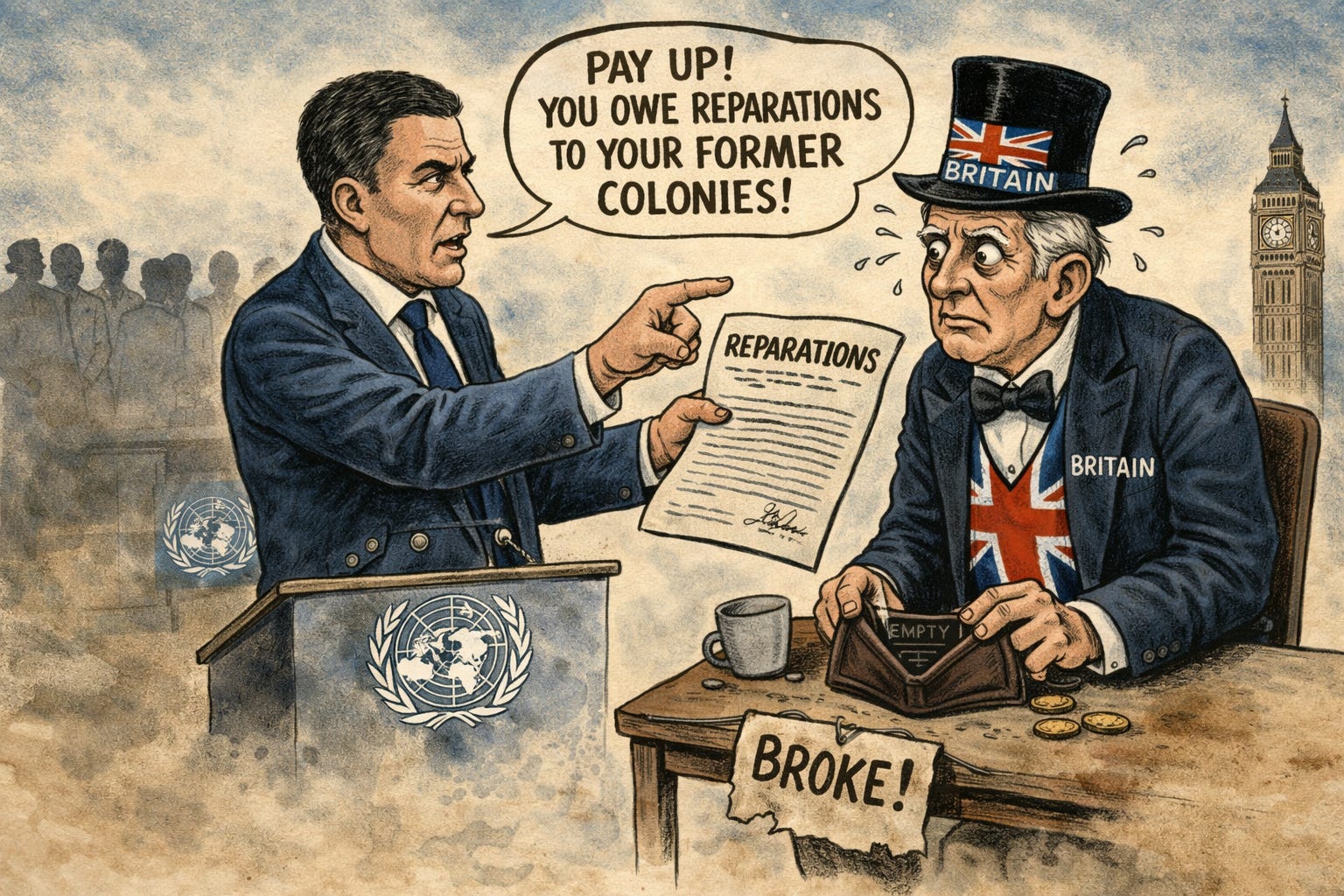
This week the United Nations passed a non binding resolution tabled by Ghana, on behalf of the African Union, that said developed countries should enter a “good-faith dialogue on reparatory justice, including a full and formal apology, measures of restitution, compensation”. Translation: give us money.
The puff piece press release is even more stark, highlighting the Ghanaian Foreign Minister’s words: “Justice does not expire with time”, and UN Secretary-General declaring apologies are not enough, instead “far bolder actions — by many more States — are needed”. And, because it’s the UN, the same release goes on to quote two poets using “spoken-word storytelling to connect remembrance with responsibility”.
This goes deeper than a non binding resolution at the UN, however poetic. The Telegraph has reported on African Union plans to pursue Britain for reparations through international courts, underpinned by a United Nations resolution, just as we have seen with the case against Chagos.
Pursuing Britain for its role in the international slave trade is, of course, particularly mental. There is no country on earth that did more to put a stop to the transatlantic slave trade. Slavery and coerced labour existed as far as we know in every society that has ever existed on this planet. And Britain was the first major country to permanently ban the trade.
It has often been argued that this is thanks to the moral character of the British, with a romantic or religious rose coloured filter. But the genuine religious morality of people like William Wilberforce could not have won were it not for an economic imperative.
The reason Britain could permanently put a stop to the slave trade first is that Britain was the first to industrialise. Yes our institutions, enlightenment, literacy, protestantism, and classically liberal political class all helped but the blunt fact is that until human labour could be replaced by coal, iron, and steam, that very same human labour would be shamefully bought and sold.
Africans were rounded up and sold by Europeans, Arabs, and yes other Africans. Slaves were a fact of life in Southeast Asia, Ancient Egypt, the Roman Empire, China, Mongolia, Japan, across the Middle East, and even amongst the Aztecs, Incas, and other native peoples of the New World. Slavery was everywhere. What we should ask ourselves is not the almost tautological question ‘how did this ubiquitous practice happen in the first place?’, but rather ‘how did it end’?
It took considerable blood and treasure of the Royal Navy to end the trade, catching slaving ships, freeing slaves, and then often turning the captured ships to the task of themselves freeing more slaves, as part of the West Africa Squadron (formed 1808, the year after Britain abolished the slave trade).
HMS Black Joke (itself a captured Brazilian slaving ship originally named Henriquetta) alone was celebrated for catching six ships linked to the slave trade: Providentia, Vengador, Presidente, Marianna, El Almirante, and El Hassey. In total the West Africa Squadron seized more than 1,500 slave ships and freed about 150,000 Africans.
On land from Lagos (1851) to Zanzibar (1873/1897), Britain launched operations against African countries the breadth of the continent often explicitly to impose treaties ending the slave trade upon local leaders. Even today in Brazil there is a phrase in common parlance ‘para ingles ver’, or ‘for the English to see’, dates back to a treaty signed in 1826 when Britain attempted to force Brazil to end the slave trade. Brazil reneged on the treaty, and in total transported more than ten times the number of slaves to its shores than the United States of America did to its.
One of the most impressive statesmen of British history, Lord Castlereagh, leveraged the diplomatic might of the British Empire at the end of the Napoleonic wars to force a declaration of the parties to the Congress of Vienna to condemn the slave trade as “repugnant to the principles of humanity and universal morality”, and committing to future abolition. Of course it took many of the signatories decades longer than Britain to finally carry through with their promises.
To demand Britain, of all countries, pay reparations for slavery is a demand deeply ignorant of this island’s history. While of course British people - like those of all other major countries - initially played a significant role, the facts are simply overwhelming and unarguable: no other nation on earth has done more to end the transatlantic slave trade than the British.
The Welfare of Nations…
Beyond the mathematics of compound interest, and the moral points on slavery, there is one further element of reparations discourse that needs addressing. The idea that countries got rich through slavery or colonisation. The opposite is true.
Too many approach the issue with a zero sum mindset, imagining there is a fixed amount of wealth in the world and that conquering another part of it allows you to extract the fixed wealth that exists there. This is, of course, baloney.
Britain did not become rich because it colonised a third of the world. Britain colonised a third of the world because it became rich.
The fact that Britain was the world’s first industrial nation is the precise reason why Britain became the world’s sole superpower through the 19th Century. Wealth was created beyond the wildest imagination of generations beforehand through industrial production, invention, and specialisation.
And yet, for all the riches of global dominance, Britain at the height of its imperial power in 1913 was per person poorer than Ghana (with all its demands for reparations) is today. Per person, today’s Nigeria is 55% richer than Britain was then. And looking at total inflation-adjusted GDP, little Singapore alone now has a larger economy than all of Britain did on the eve of the First World War.
Because there is not and never has been a fixed amount of wealth. Economic history has taught us that wealth is created through specialisation and institutions, not through conquering other peoples.
It is particularly peculiar to see former colonies argue for compensation from Britain today when we can plainly see that it is the economic choices made by the governments of those countries since decolonisation that has led to a remarkably varied spread of outcomes. Many African colonies of Britain have sadly succumbed to revolutionary communist and deeply corrupt governance in the post colonial age. It is sixty or seventy years of bad governance that explains the lack of wealth in many of these countries, not a legacy of colonialism.
Indeed many countries have used their own legacy of colonialism to their advantage, with the English language being one of the most valuable assets a workforce can possess in the modern world.
Some former British colonies are poor. Other former British colonies are amongst the richest places in the world. At some point former colonies will have to accept that they are in control of their own economic future, and that a countries’ wealth is never made by extracting it from others.
To return to the slave trade one last time, recent research revealed slave-based sugar plantations added just under 2.5% to the value of the British economy at their very peak, less than the share of sheep farming. Non mechanised agriculture is not how countries develop. Industry is.
Poor countries don’t need reparations to get rich. And ‘reparations’ cannot justifiably be granted to the great great great great great grandson of a slave any more than an Anglo Saxon like me can demand repayment of the Viking Danegeld from the people of Denmark.
Countries wasting their energy attempting to extract reparations from Britain would do better to focus on the issues of governance failures, corruption, and destructive market intervention that are genuinely keeping them poor. Everything else is a convenient distraction.