
No, Britain doesn't have free speech, and now the government has made things worse
Why does the media continually let the Prime Minister get away with his favourite lie?

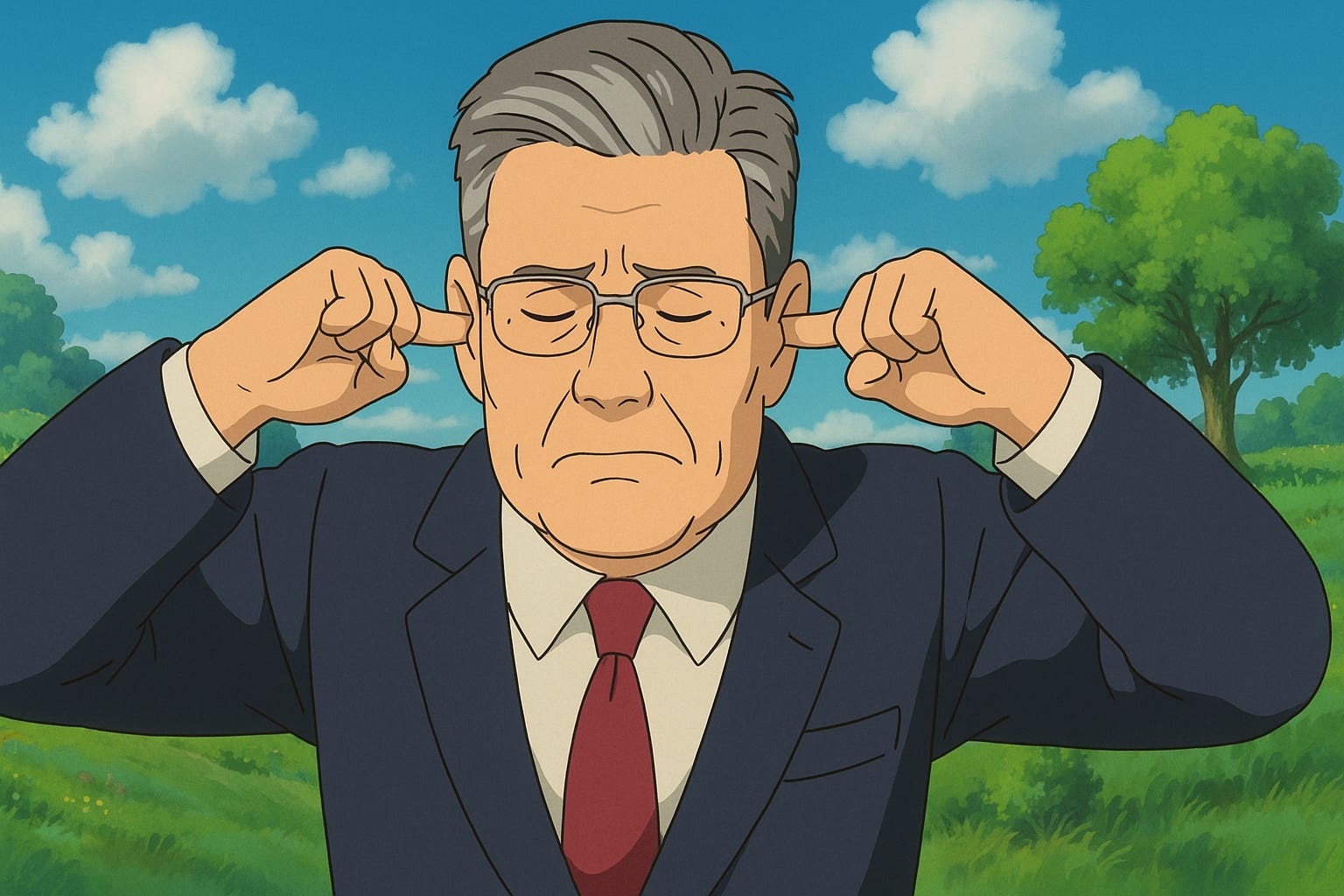
“Free speech has been in this country for a very long time, we are very very proud of it, we will protect it forever.”
“We’re not censoring anyone”
"We have a long history of free speech in this country. I'm very proud of that and I will always defend it."
"Free speech is one of the founding values of the United Kingdom, and we protect it jealously and fiercely and always will"
How many lies can the Prime Minister tell before breakfast? One of Sir Keir’s favourite refrains is to claim - without evidence - that Britain enjoys free speech. That we have done for a long time, and that he - personally - will always defend it.
He has said a variation of that line time and time again, particularly in the presence of Donald Trump. And - somehow - he always gets away with it.
Standing at his podium alongside the President of the United States yesterday, Mr. Starmer revealed where he claims he believes free speech ends: “I draw a limit between free speech and the speech of those that want to peddle paedophilia and suicide (on) social media to children.”
To most of us that sounds entirely reasonable. Examples of real world action. Incitement, if you will. But does this Prime Minister’s history - or indeed current government policy align with the hard reasonable limits he set out in front of the world’s media? Unfortunately for Sir Keir, I’ve kept receipts.
As Director of Public Prosecutions, a man who was then known as merely Mr. Keir Starmer QC reportedly stopped his staff dropping its case against Paul Chambers, author of a Twitter joke about blowing up Doncaster Sheffield Airport.
In early January 2010, what was then known as Robin Hood Airport cancelled its flights due to bad weather. In light hearted frustration, Chambers tweeted to his 600 followers: “Crap! Robin Hood airport is closed. You've got a week and a bit to get your shit together otherwise I am blowing the airport sky high!!”
Police arrested him while he was at his workplace. Starmer’s CPS had decided to charge him with sending a message "of a menacing character" - an offence under Section 127 of the Communications Act (2003).
Four months later he was found guilty at Doncaster Magistrates' Court. He was fined £385. He was ordered to pay £600 costs. He lost his job.

It didn’t matter that the airport in question considered the message to be “not credible” as a threat. It didn’t matter that no one in this process considered Paul Chambers to be remotely terroristic. Mr. Starmer’s CPS prosecuted Chambers not for making a credible threat, not for inciting violence, not for any speech test that would lead to real world harm - but instead for speech that could be interpreted as “menacing”.
Chambers then lost an appeal against his conviction at Doncaster Crown Court. It was only after a second High Court appeal that he was able to beat back Starmer’s CPS, with the help of some of the most expensive QCs in the land.
Needless to say not all speech criminals achieve the level of publicity, sympathy, and support that Chambers was able to garner through his two and a half year ordeal. The Communications Act (2003) has continued to criminalise speech that would in a freer society be completely legal.
The Robin Hood Airport incident was far from isolated.
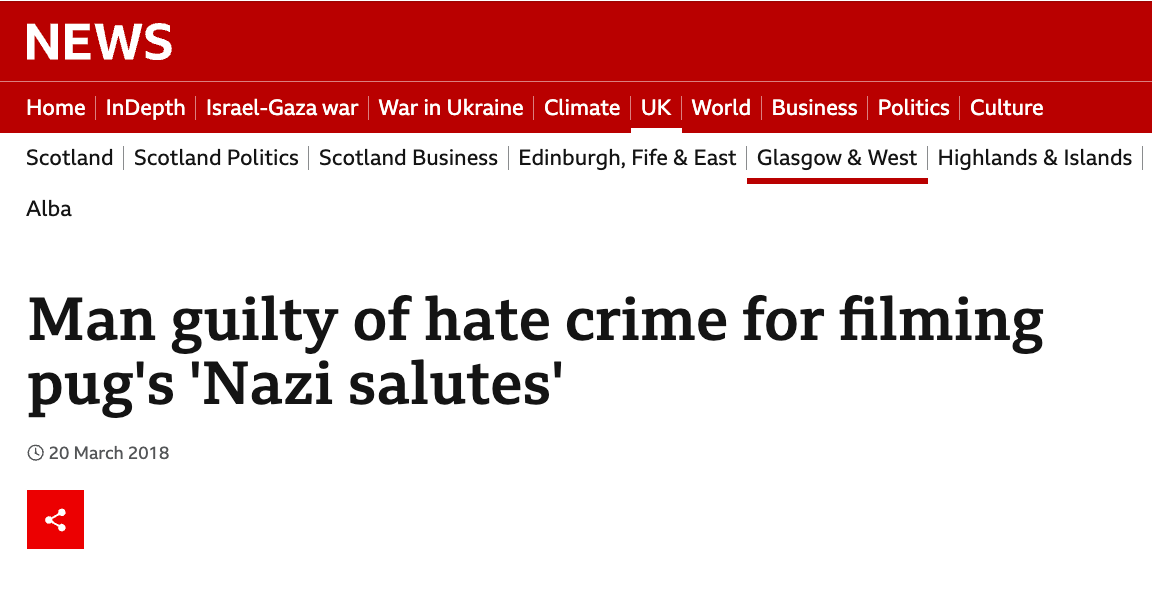
A Scottish YouTuber known as Count Dankula taught his girlfriend’s pug to raise its paw in the manner of a Nazi salute in response to the phrase “Do you wanna gas the Jews?”. Dark, yes. Comedy? Questionable. Offensive? Certainly.
And that was where he went wrong. Under the Communications Act (2003) it is illegal to post "grossly offensive" communications. In April 2018, Dankula (real name Mark Meechan) was fined £800.
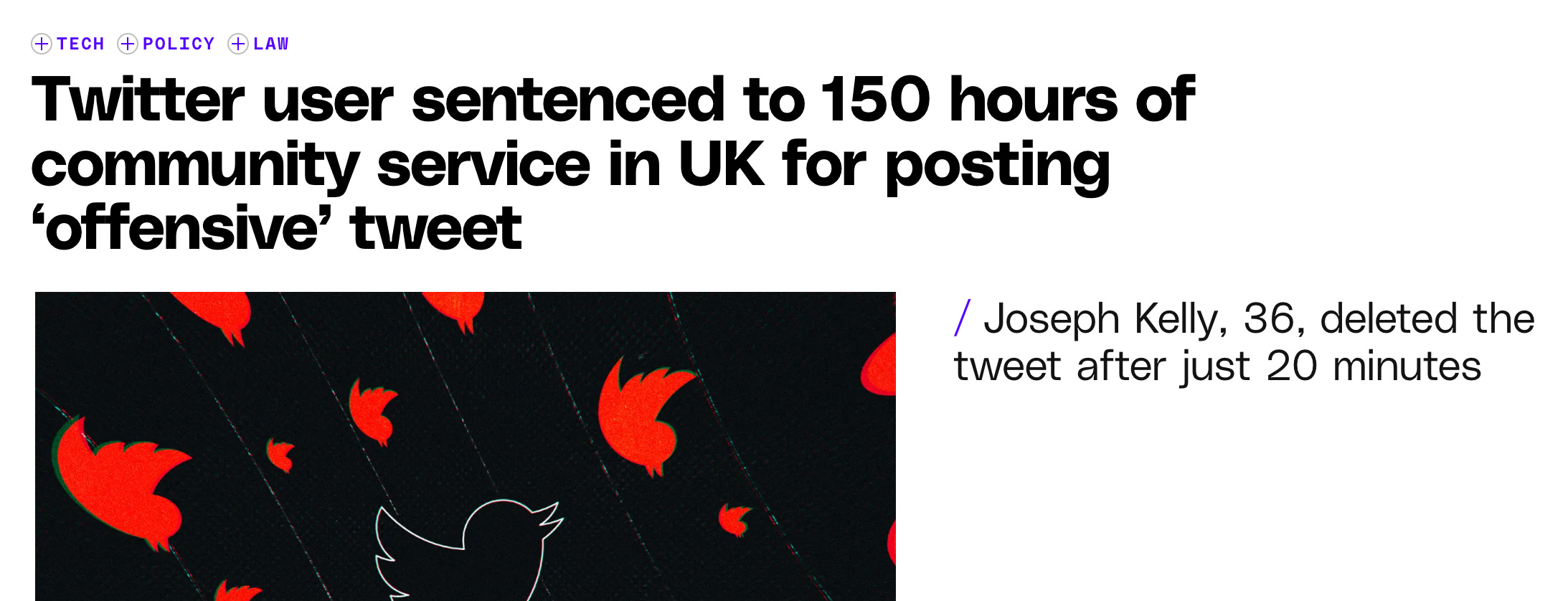
Another Scot, called Joe Kelly tweeted “the only good Brit soldier is a deed one, burn auld fella buuuuurn” along with a picture of the late Captain Tom. Kelly had just a couple of hundred followers at the time. The tweet was deleted after 20 minutes.
For this one post - online for one third of one hour - Kelly was wrung through the courts for a year and a half. He was finally sentenced in March 2022. The judge said:
“He accepts he was wrong. He did not anticipate what would happen. He took steps almost immediately to delete the tweet but the genie was out of the bottle by then.”
“His level of criminality was a drunken post, at a time when he was struggling emotionally, which he regretted and almost instantly removed.”
Nevertheless, Kelly was sentenced to 150 hours of unpaid work, and 18 months of supervision. He had fallen foul of the “grossly offensive” test under the Communications Act (2003).
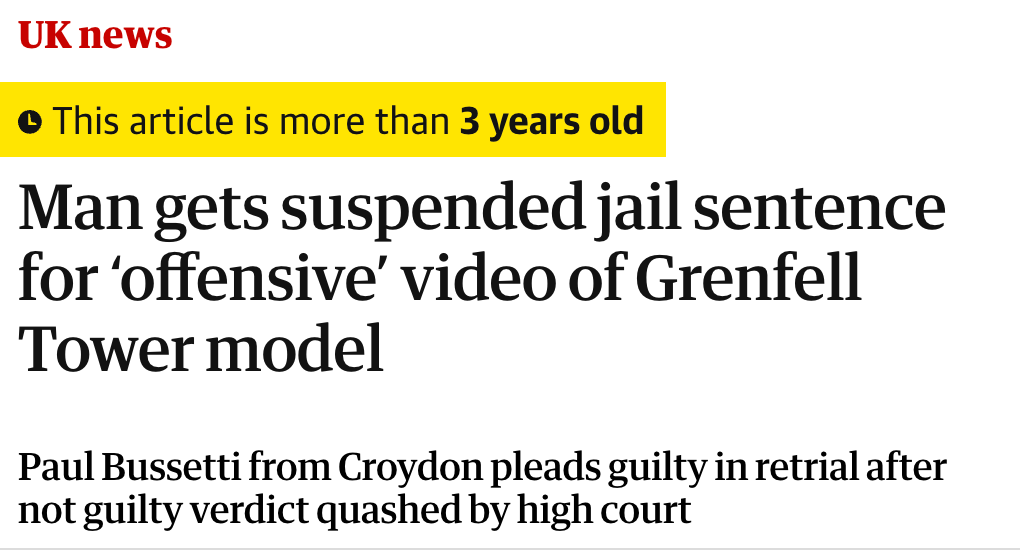
Elsewhere - in England, 2018, Paul Bussetti attended a Bonfire Night party at a friend’s house. Some guests brought effigies (including a cardboard model of Grenfell Tower) to burn.
Among other offensive and topical effigies, Bussetti filmed the burning of that Grenfell Tower effigy with his phone, then later that evening sent the video to two private WhatsApp groups - one with fourteen friends, the other containing six.
The video was then forwarded on and made its way to social media. By April 2019, Bussetti was charged with “Sending or causing to be sent grossly offensive material” under the Communications Act (2003).
In August 2019 Bussetti was acquitted at Westminster Magistrates' Court, but the Crown Prosecution Service appealed. His acquittal was quashed by the High Court. In April 2022, he was back at Westminster Magistrates' Court, pleading guilty this time. After four years being put through the legal wringer, he was handed a ten week suspended jail sentence.
These are just instances that became national news stories. When the pressure group Big Brother Watch ran a campaign on Section 127 in 2013, they found that from November 2010 to November 2013, 2,666 charges had been brought under Section 127, with 1,236 cautions handed out too. That’s two and a half charges and one caution each and every day. Police involvement and court time for people being ‘offensive’ online.
Now the Government is making it worse.
To their credit the previous government could see Section 127 of the Communications Act as particularly bad legislation. At the very least outdated legislation. Drawn up before an age of social media. Before online communication became less like putting up posters around your local community and more like any conversation you might have down the pub.
While I have been a fierce critic of the Online Safety Act, I can recognise elements of that behemoth that were designed to make things marginally better. Most notably the wider repeal of Section 127 of the Communications Act.
The OSA introduces new criminal offences around harmful, false, and threatening communications - designed to be more specific and less widely interpretable than the “grossly offensive” test of the 2003 Act.
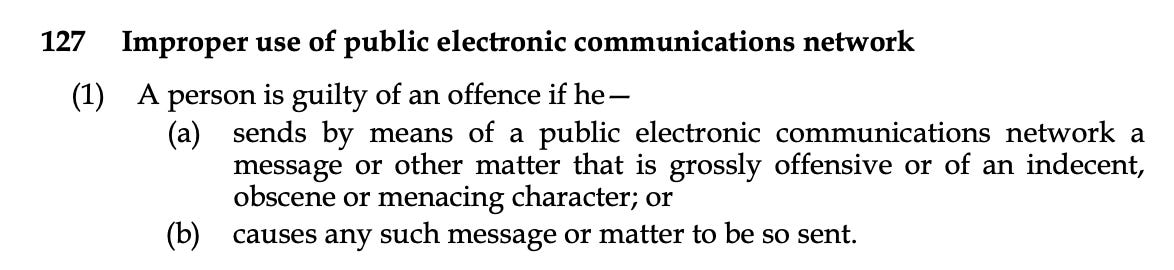
The Online Safety Act commensurately gave the Science and Technology Secretary powers to repeal these parts of the Communications Act. But you’ll never guess what’s happened so far…
The government has of course enacted the replacement regulations contained in the OSA, those new restrictions on…
“threatening communications” (outlawing messages that conveys a serious threat of serious harm)
“harmful communications” (outlawing messages where the sender intends to cause psychological harm amounting to serious distress)
“false communications” (outlawing messages which convey information that the person knows to be false)
The first of these is clearly justified in my view, but there is a question of a motte and bailey tactic a reasonable first point (motte) before retreating up to the bailey for the harder to defend speech restrictions - who gets to define what messages cause psychological harm? Should lying on the internet really be illegal?
But whatever you think of these restrictions under the Online Safety Act they are a world of improvement compared to the Communications Act restrictions they were designed to replace.
Notice my phrasing “designed to replace”? Because they haven’t replaced Section 127. So far they have only added to the pages and pages of speech law stifling the United Kingdom.
The Science and Technology Secretary has the power to at any time commence the repeal of the ‘grossly offensive’ parts of Section 127 by statutory instrument under the Online Safety Act - with the stroke of a pen. This would mean no more arresting people purely for offensive jokes. Strangely, however, this government is dragging its feet.
Britain does not have free speech. Today we face more legislative restrictions on our speech than we have seen in decades. The government could make things freer without even passing any more legislation. Strangely it has thus far chosen not to.
Perhaps our dishonest Prime Minister ought to reflect on these facts the next time he claims "We have a long history of free speech in this country. I'm very proud of that and I will always defend it."
Now that is an offensive joke.